

Booked as Kurt Kovain: How a Ten-Song Demo Made the Melvins the Hidden Rhythm Section of Grunge
Most lineage stories are told in adjectives: this band sounded like that band. The Melvins and Nirvana have a rarer kind of link, one you can date. On 23 January 1988, in Seattle, Melvins drummer Dale Crover sat behind the kit for a ten-song Nirvana demo, according to the Melvins’ Wikipedia entry. Some of those songs later became part of Bleach. The session was booked under a misspelled name, Kurt Kovain.
That detail is usually told as trivia. It is better understood as a job description. For a few hours, the drummer of the band everyone in the region was copying became the rhythm section of the band that would make the region famous.
A Slow Band From a Small Town
The Melvins formed in early 1983 in Montesano, Washington, a logging town where the school and the rehearsal room were the same social circle. Buzz Osborne, Matt Lukin and Mike Dillard had all attended Montesano Jr./Sr. High School. Their debut EP, Six Songs, was recorded live to two-track at Ironwood Studio in Seattle on 8 February 1986. Gluey Porch Treatments followed, recorded in October 1986 in Sausalito, California, and released in 1987 on Alchemy Records.
What made them useful to other bands was tempo. Hardcore had trained a generation to play fast. The Melvins slowed riffs to a crawl and let the amplifier do the work, an approach later labelled sludge. For a young band with more songs than technique, that was permission: you could be heavy without being quick.
The Version of the Story That Holds Up
Nirvana’s reputation as the Melvins’ successor is well documented. Lou Barlow nicknamed them Melvins Junior, and Kurt Cobain named the band as a major influence, as PopMatters notes in its 30th anniversary piece on Houdini. Osborne also introduced Cobain and Krist Novoselic to Dave Grohl, which makes the Melvins the unlikely matchmaker of the most famous lineup in 1990s rock.
Some of the more repeated details deserve caution. The roadie story that circulates about Cobain is not supported by the sources I checked, so it stays out of this piece. The production credits on Houdini are another case. The liner notes list Cobain as co-producer on six tracks, with guitar on Sky Pup and percussion on Spread Eagle Beagle, but PopMatters calls the credits somewhat dubious and reports that Osborne rejected Cobain as producer.
The Day the Order Flipped
Houdini came out on Atlantic in September 1993, the same day as In Utero. About three-quarters of the songs are in drop-D, which Osborne has described as a car wreck sound, and the tempos stay low and heavy. It entered the Billboard Heatseekers chart at number 29. Atlantic dropped the band in 1997 after three records.
So the sequence runs in an unusual direction. The Melvins began the style, loaned Nirvana their drummer, saw Nirvana become enormous, and then got a major label deal because of it. The influence arrived first, and the money came later and briefly.
Why It Still Matters to Guitar Records
If you listen to heavy guitar bands now, the Melvins’ fingerprints are everywhere: down-tuned riffs, patient tempos, a drummer who plays like a second lead. Stoner, doom and sludge acts rarely cite them as a formula. They cite them as proof that a band can be slow, strange and loud, and still be taken seriously.
The demo is the cleanest evidence. A drummer from Montesano, a misspelled name on a booking sheet, and a recording that survived into one of the most important debut albums of its decade. Influence rarely leaves such a receipt.
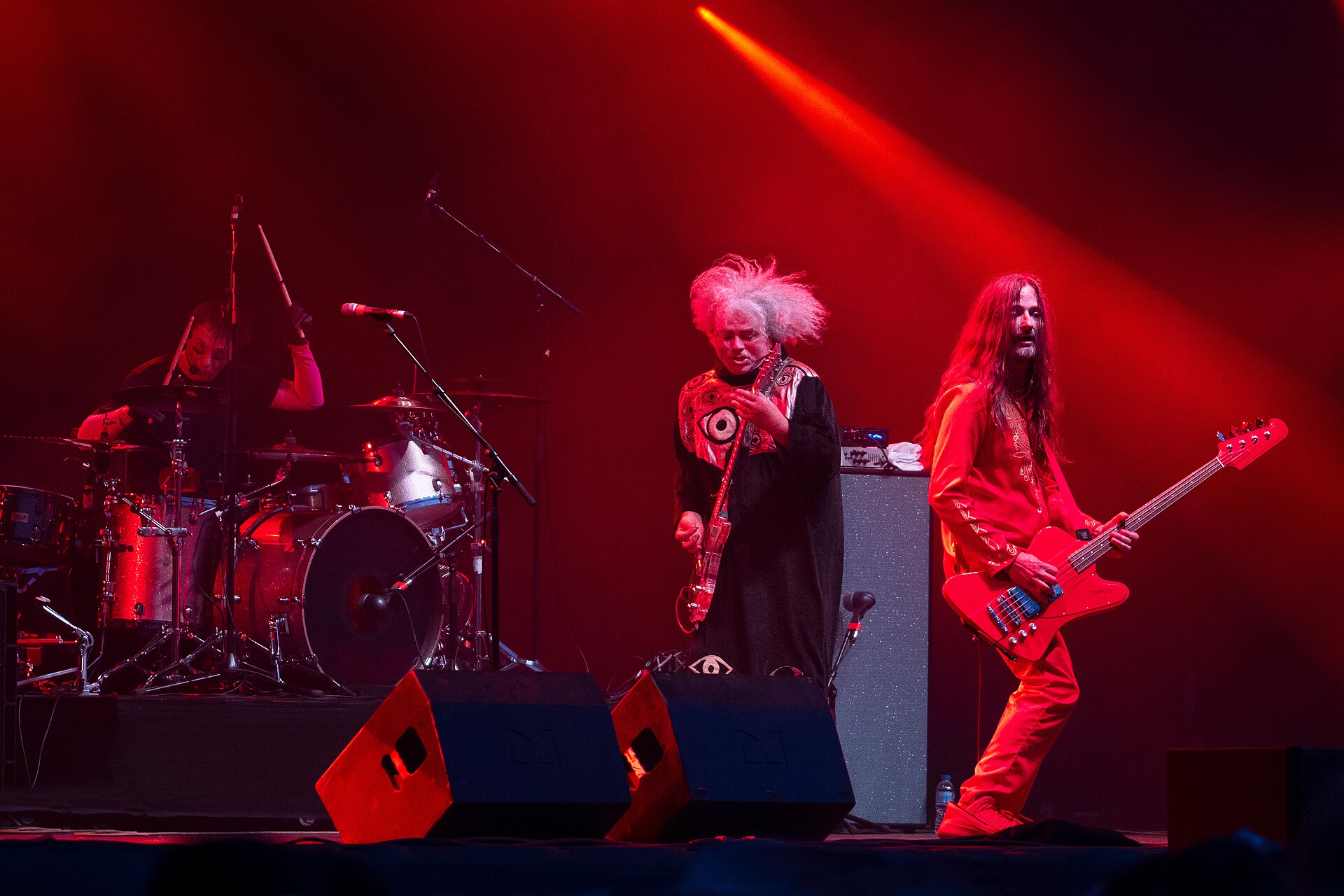
Cover photo: Selbymay, CC BY 4.0, via Wikimedia Commons





Leave a Reply