

The Show Came in a Sleeve: How Hawkwind Turned a Stage Production Into a Double Album and Reached the UK Top Ten
Most live albums are a souvenir. A band plays, a truck parks outside, and the tapes are sorted out afterwards. The Space Ritual Alive in Liverpool and London, released by United Artists on 11 May 1973, was something closer to a cast recording. Hawkwind did not simply document a gig. They documented a production, with a poet, dancers, a light show and a continuous flow of sound that was designed to have no gaps.
A tour built as theatre
The material came from the winter 1972 tour for Doremi Fasol Latido. Two of the shows that fed the record were at Liverpool Stadium on 22 December and at the Sundown in Brixton, London, on 30 December, with a Sunderland date in between that also survives on tape. Over those weeks the group stopped behaving like a band that plays songs and started behaving like a ship’s crew. The conceit, as the later reissue notes tell it, was a journey through space and time, held together by the idea of the music of the spheres.
The stage was dressed by the designer Barney Bubbles, the lights were handled by Liquid Len, and the poet Robert Calvert stood in the middle of it all reciting his science fiction verse between the songs. Stacia, the group’s long-time associate, danced as a central part of the spectacle. For a rock audience in 1972 this was not a normal evening, and the album keeps that strangeness intact.
Lemmy and the bass as engine
Underneath the theatre sat a rhythm section that almost nobody was imitating. Lemmy, then a guitarist-turned-bassist who had been in the band only a short time, played bass with a driving, chordal attack that pushed the whole set forward. Beside him Simon King kept the drums locked to a relentless pulse, while Dave Brock’s guitar chopped at the same few chords for minutes at a time. Dik Mik’s audio generator and Del Dettmar’s synthesizer supplied the electronic weather, and Nik Turner’s saxophone and flute drifted across the top.
The point is that this was guitar music with the repetition turned up until it became a place. Where other heavy bands of the period built songs around a riff and a solo, Hawkwind built an environment. It is easy to hear why punk and later stoner and space rock bands claimed the record, and why it sits so close to the krautrock records being made in Germany at the same moment.
The sleeve as programme
The packaging carried the same logic. Barney Bubbles designed a sleeve that unfolded into a large panel, with colour on the outside and a monochrome universe on the inside. Accounts of the design point to a mix of influences, among them Egyptology, Art Nouveau posters, op art and Kubrick’s 2001. Bubbles, who later became one of the defining sleeve designers of British independent labels, treated the cover less as a picture and more as a programme you could keep. The audience at the shows had received a printed programme with a short story, and the album repeated that gesture for people who had missed the tour.
Why it matters now
The record reached the UK Top Ten, a notable result for a double live album from a band that most of the press ignored. It has been reissued repeatedly, and in 2023 a large box set restored the unedited shows from the original multitrack tapes. That says something about how the album is heard today. It is no longer a souvenir of one winter. It is a template for what a live record can be when the band treats the room as part of the instrument.
For anyone who plays through a wall of amplifiers or builds long loops of sound, Space Ritual remains a good test. If your set can survive an hour without stopping, you are working in the lineage Hawkwind set out in December 1972.
Sources: Wikipedia entry for Space Ritual, Louder (Classic Rock) feature on the sleeve, The Second Disc and The Arts Desk coverage of the 2023 reissue.
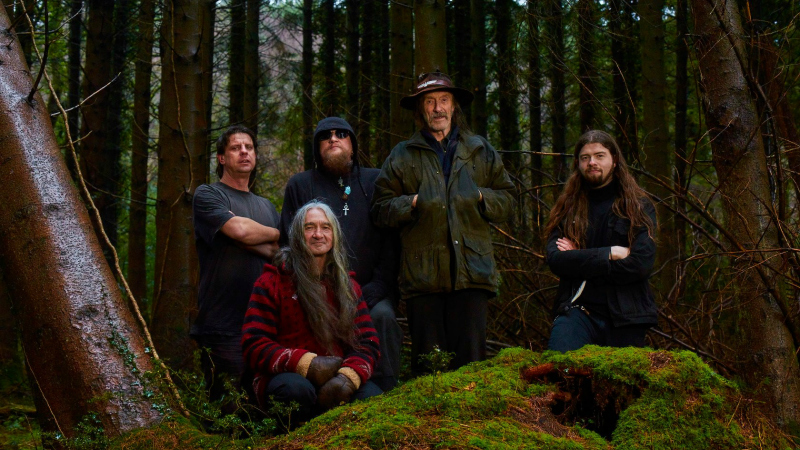
Cover photo: Michael Reason-Wiki, CC BY-SA 4.0, via Wikimedia Commons






Leave a Reply