

A Light Bulb in a Box: How the Uni-Vibe Faked a Rotating Speaker and Found Its Own Voice
In the late 1960s, the sound every organ player wanted came out of a piece of furniture. The Leslie speaker cabinet spun its horn and drum so the notes swirled around the room, and guitarists wanted that swirl too. The problem was the cabinet itself: Guitar Player puts its weight at around 140 pounds, which is a lot to carry to a gig for one effect. In Japan, an engineer named Fumio Mieda tried to put the motion of a Leslie into a box you could set on top of an amp. He did not quite manage it, and that failure is why the Uni-Vibe still matters.
Four Photocells and One Bulb
Mieda’s design is usually described as a phase shifter, but it works in an unusual way. Inside the box, a single incandescent bulb sits in a small light shield, surrounded by four light-dependent resistors, or photocells. An oscillator makes the bulb brighten and dim. As the light changes, the resistance of each photocell changes with it, and each photocell sits in its own phase-shifting stage of the circuit. The guitar signal passes through all four stages, and its timing gets pushed back and forth as the bulb pulses.
The detail that gives the Uni-Vibe its character is that the four stages are not identical. A conventional phaser lines its stages up so the notches in the sound sweep together, neatly and evenly. Mieda staggered his. Each stage is tuned slightly differently, so the shifts do not move in step, and the result is less of a clean whoosh and more of an uneven, liquid throb. Strymon, which has studied the circuit closely, notes that despite the word on the switch, it does not really sound like a chorus pedal. Guitar Player calls it a phaser that meets a chorus. Both are trying to describe something that only exists in this box.
A Keyboard Unit on the Floor
The early history moved through several names. Guitar Player traces the design to a Japanese unit sold around 1967 as the Honey Vibra Chorus. When Honey collapsed, Shin-ei took over production in 1968, and the unit reached North America that same year under the Univox brand as the Uni-Vibe. Mieda’s own stories about where the idea came from vary. In interviews he has pointed to the way shortwave radio signals wavered in the atmosphere as much as to the Leslie.
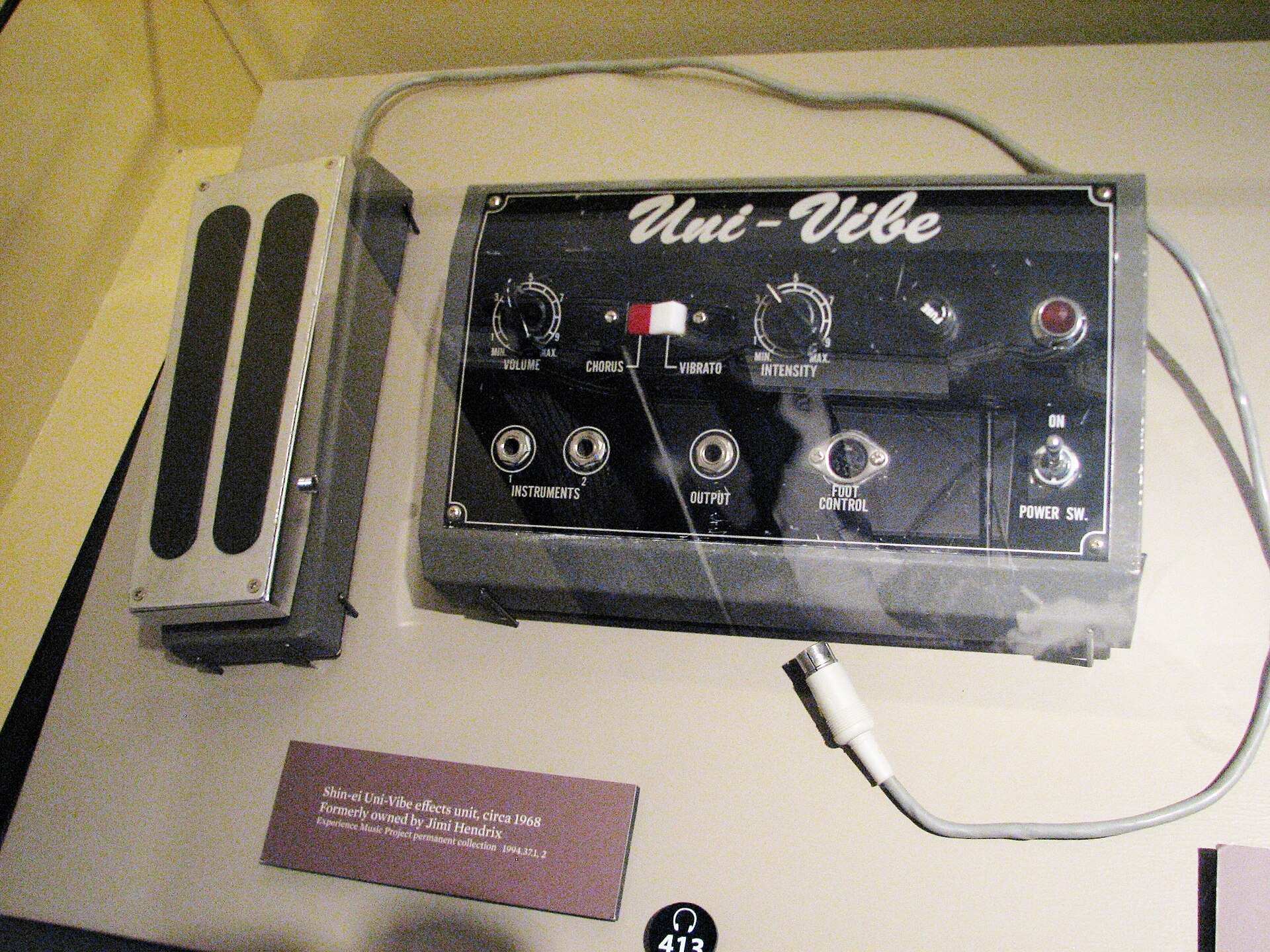
The box was not built like a stompbox. It sat on a table or an amp, with a separate treadle that controlled the speed of the bulb, the way an organist works a Leslie. Guitar Player notes that rocking the treadle all the way back stopped the effect, and the original had no true bypass. A two-way switch chose between Chorus, which mixed the dry guitar back in, and Vibrato, which sent out only the wobbling signal.
Machine Gun, Breathe, Bridge of Sighs
Jimi Hendrix got a Uni-Vibe around 1969, about a year before he died, and it was the last effect to join his setup. Because it arrived so late, it is mostly heard on his final recordings. The best known is Machine Gun on Band of Gypsys, where the slow throb makes held notes sound like they are breathing, and Guitar Player also lists the Star-Spangled Banner at Woodstock. A Shin-ei unit dated to around 1968 and formerly owned by Hendrix later went on display at Seattle’s Experience Music Project, as the photo above shows. According to his NAMM oral history, Mieda did not learn that Hendrix had used his invention until about ten years later.
Other players took it in different directions. David Gilmour used it on Breathe, on Pink Floyd’s The Dark Side of the Moon in 1973, where it softens the guitar into the band’s slow drift. A year later Robin Trower built much of the sound of Bridge of Sighs around it, slowing the speed down until the guitar seemed to sink and rise.
The Sound of a Near Miss
The Uni-Vibe never sounded like a real Leslie, and it never needed to. Its lessons are practical. A part that drifts, like a bulb warming and cooling, can feel more alive than one that is precise. Stages that disagree with each other can be more musical than stages that agree. Original units became collector items, selling for well over 1,000 dollars by 2008 according to Premier Guitar, and Dunlop now owns the name. Every vibe pedal on a pedalboard today is still chasing the same imperfect box: one flickering light bulb, four photocells, and an engineer who aimed at a rotating speaker and hit something else.
Cover photo: ~Jen~ from Victoria BC, Canada, CC BY 2.0, via Wikimedia Commons







Leave a Reply