

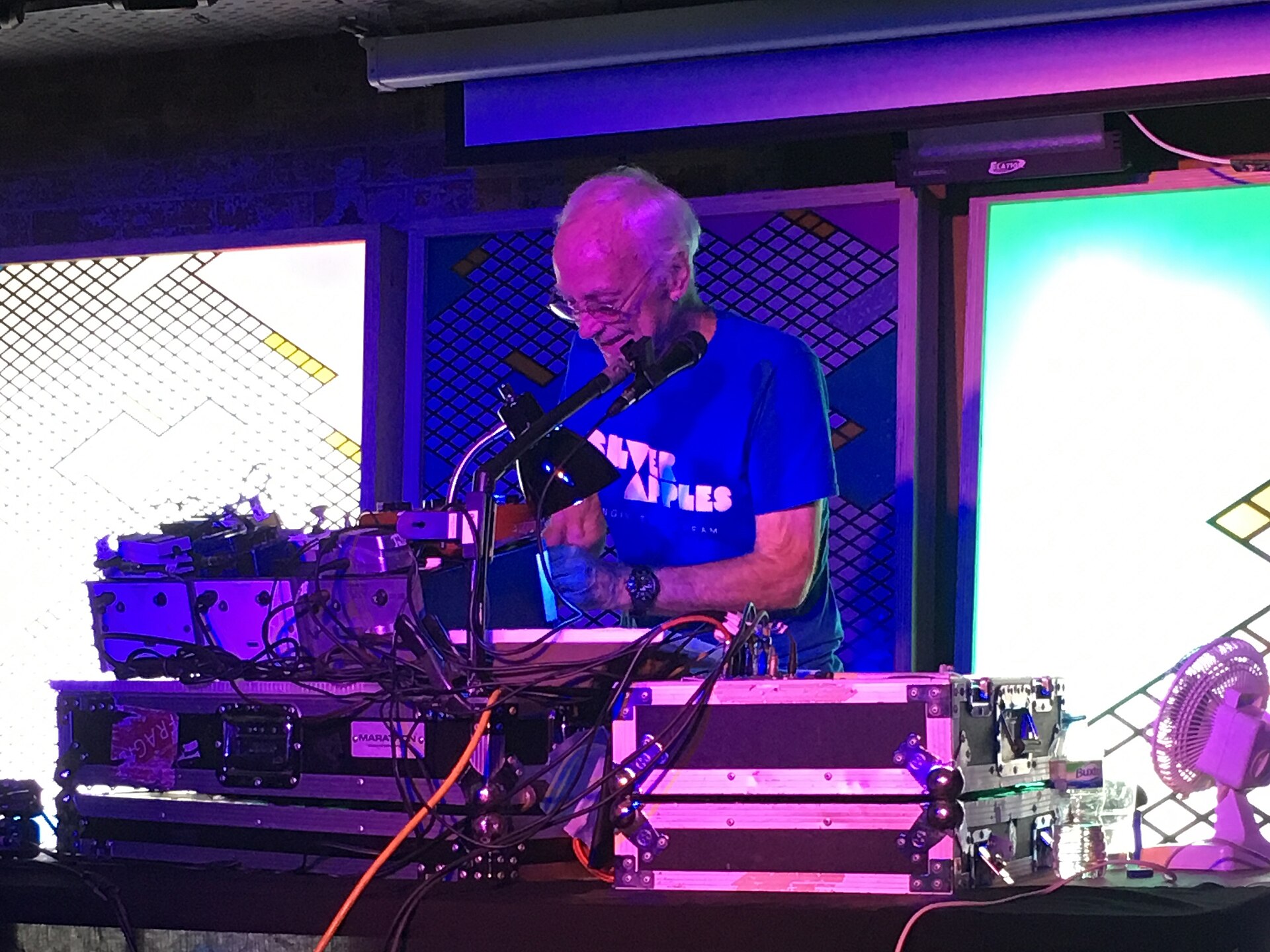
Nine Oscillators and a Drummer: How Silver Apples Wired Electronic Sound Into Rock Before Anyone Had a Name for It
Lineage in electronic music usually gets drawn through machines with brand names: Moog, Roland, Korg. One of its earliest branches runs through a machine with no brand at all. In New York in 1967, a singer named Simeon Coxe started plugging a vintage audio oscillator into a cover band’s set. Out of that experiment came Silver Apples, a duo that played rock songs on electronics before the vocabulary for doing so existed, and whose records kept resurfacing in other people’s music for the next fifty years.
A Band That Shrank to Two
Coxe was the singer in a working East Village group called the Overland Stage Electric Band. When he began feeding a 1940s oscillator into the shows, the rest of the band objected and drifted away. Only the drummer, Danny Taylor, stayed. The two renamed themselves after a line in a William Butler Yeats poem and started building a sound around Taylor’s drums and Coxe’s growing pile of electronics.
Coxe had no formal training and never learned to play a conventional keyboard. Instead he collected cheap oscillators from army and navy surplus stores and wired them into a rig that came to be called the Simeon. The liner notes of the first album describe nine oscillators stacked on top of each other and 86 manual controls, played with hands, feet and elbows through telegraph keys and pedals. Billboard said the contraption sounded like “a mating call between two IBMs.”
Two Albums and a Lawsuit
The duo signed with Kapp Records, a label better known for easy listening, and released Silver Apples in June 1968. It reached number 193 on the Billboard album chart, the band’s best showing. Most of its lyrics came from the poet Stanley Warren, and its opening track, Oscillations, became the band’s signature. Taylor’s tuned, repetitive drumming has often been compared to krautrock, a scene that had not yet released a record.
The second album, Contact, came out in 1969 and ended the band. Pan Am had agreed to let the duo shoot the cover in one of its cockpits in exchange for showing the airline’s logo. The back cover showed the pair among the wreckage of a crashed plane. Pan Am sued, the record was pulled from shops, and Coxe later recalled city marshals confiscating equipment from the stage at Max’s Kansas City. Kapp, already in trouble, was folded into MCA, and a third album sat unreleased. Coxe left music and moved to Alabama.
The Records Kept Moving Without the Band
The lineage carried on without its makers. In New York, Alan Vega of Suicide named Silver Apples among the artists who inspired him, alongside the Velvet Underground and Iggy Pop. Suicide’s own formula of a singer over a cheap electronic pulse looks, in hindsight, like a harder, city version of what Coxe and Taylor had tried a few years earlier.
In the 1990s the line passed to British and European groups working between drones and pop. A German label issued a bootleg CD of both albums in 1994, and in 1996 the British label Enraptured released a tribute record with Windy and Carl, Amp and the Third Eye Foundation, among others. Stereolab and Spacemen 3 are regularly listed as descendants. The attention persuaded Coxe to re-form the band in 1996, and in 1998 Taylor turned up with the tapes of the lost third album, which finally came out as The Garden.
The clearest debt came from Bristol. Portishead built their 2008 album Third partly on krautrock and early electronics, and its track We Carry On was made as an open tribute to Silver Apples. In 2011 the band invited Coxe on stage to perform it with them at an All Tomorrow’s Parties festival in New Jersey.
What the Lineage Actually Passed On
Silver Apples did not hand down a technology. Nobody copied the Simeon, and the tools that later generations used were bought, not salvaged. What travelled was an attitude: electronics treated as a rock instrument, played live, built from whatever was cheap, locked to a human drummer and allowed to drone. You can hear that idea in Suicide’s rhythm box, in Stereolab’s organ loops and in the motorik pulse that runs through so much guitar and synth music today.
Danny Taylor died in 2005. Coxe kept performing as Silver Apples, using samples of Taylor’s drumming, until his death in September 2020 at 82. The duo sold few records in their own time, but the family tree that grew from those two albums is far larger than the band ever was.
Cover photo: Cavie78, CC BY-SA 4.0, via Wikimedia Commons




Leave a Reply