

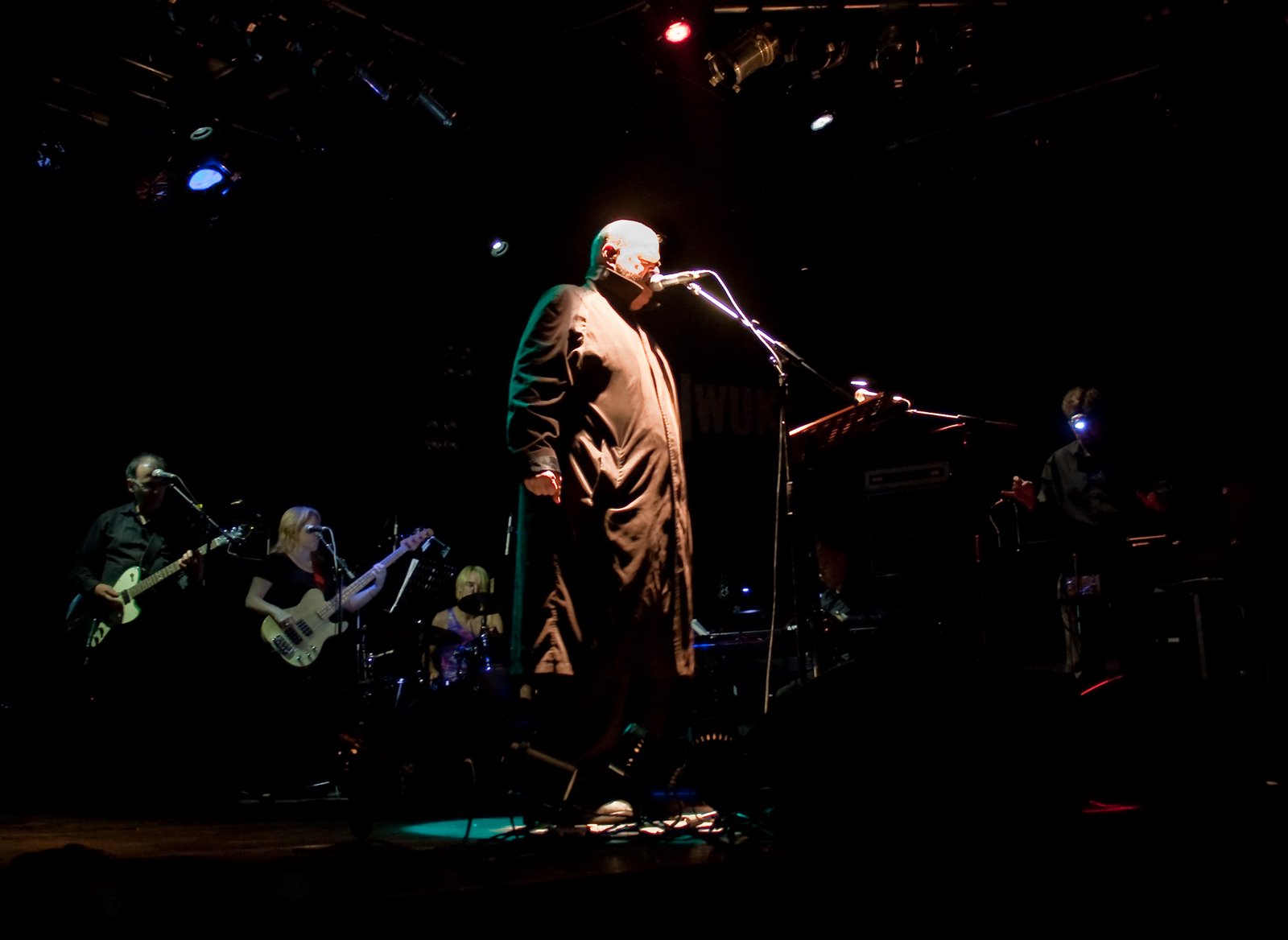
Dub on the Stereo, Row Houses Out the Window: Pere Ubu’s Dub Housing Turns 48
Forty-eight years ago today, on November 17, 1978, Pere Ubu released Dub Housing on Chrysalis Records. It was the Cleveland band’s second album of the year, arriving only months after their debut, The Modern Dance, had come out on Blank, a short-lived Mercury imprint. Where the first record announced a band, the second sounded like a place: a city of factories, rented rooms and radio static, heard through a set of ears that did not work like anyone else’s.
A Title Spotted From a Van
The name came from the road. The first show of the band’s 1978 tour was in Baltimore, and as the van drove past rows of identical terrace houses, dub reggae was playing on the stereo. Singer David Thomas pointed out of the window and said two words: dub housing. The phrase joined two things the band cared about, the repeated shapes of an American city and the echo and space of Jamaican dub, where the mixing desk is played like an instrument.
That second idea mattered. Dub Housing is not a reggae record, but it treats sound the way dub producers did, as something that can be pulled apart, dropped out and thrown into the distance.
Two Synthesizers That Were Not Keyboards
The line-up was David Thomas on vocals, organ and percussion, Tom Herman on guitar and bass, Tony Maimone on bass, guitar and piano, Scott Krauss on drums and Allen Ravenstine on EML 101 and 200 analog synthesizers and saxophone. Ravenstine is the reason the album still sounds unplaceable. His EML machines, made by Electronic Music Laboratories in Connecticut, were used less for melodies than for weather: hisses, sweeps, bleeps and rushing noise that sit between the guitar and the drums rather than on top of them.
On The Modern Dance, record company staff had reportedly mistaken some of those sounds for technical faults or bleed in the studio. On Dub Housing they are part of the architecture. Pere Ubu were a guitar band with an electronic musician inside it, years before that combination became a post-punk habit.
Eight Weeks at Suma
According to the band’s own archive, the album was recorded and mixed at Suma, Ken Hamann’s studio in Painesville, Ohio, in sessions between July 31 and September 24, 1978. Hamann engineered and co-produced with the band. The basic track of Thriller! was recorded elsewhere, at a space in Cleveland Heights the band called the Discohome, and the original LP was mastered at Air Studios in London.
The ten songs pull from everywhere. Caligari’s Mirror borrows from the sea shanty Drunken Sailor. Drinking Wine Spodyody nods to Stick McGhee’s 1949 rhythm and blues hit. Navvy and On the Surface are short and jittery, while (Pa) Ubu Dance Party and the closing Codex stretch out into something slower and stranger.
The Building on the Cover
The sleeve shows the Plaza, an apartment building at 3206 Prospect Avenue in downtown Cleveland, photographed from its back parking lot. Ravenstine owned it, and band members and other artists lived there. The young woman in the window is Jean Kormos, the band’s recurring Ubu Girl, and an extra floor was added to the building for the image. Nothing about it is glamorous. It is a home address, which is exactly the point of a record named after housing.
How It Was Heard
British critics noticed first. NME placed Dub Housing eighth among the albums of 1978 and Sounds ranked it thirteenth, and in the United States it reached ninth place in the Village Voice Pazz and Jop critics’ poll. Decades later Trouser Press called it “simply one of the most important post-punk recordings.” The album has been reissued several times since, including by Fire Records in 2015 as part of a box set of the band’s early years.
Pere Ubu are often named as an influence on bands from Joy Division to Pixies and Hüsker Dü, and Dub Housing is a good place to hear why. It showed that a rock band could leave space in its songs, let noise carry feeling and use a synthesizer as a texture rather than a lead instrument. On its anniversary it still sounds less like 1978 than like a city at night, heard from a passing van.
Cover photo: Sonictruth, CC0, via Wikimedia Commons




Leave a Reply