

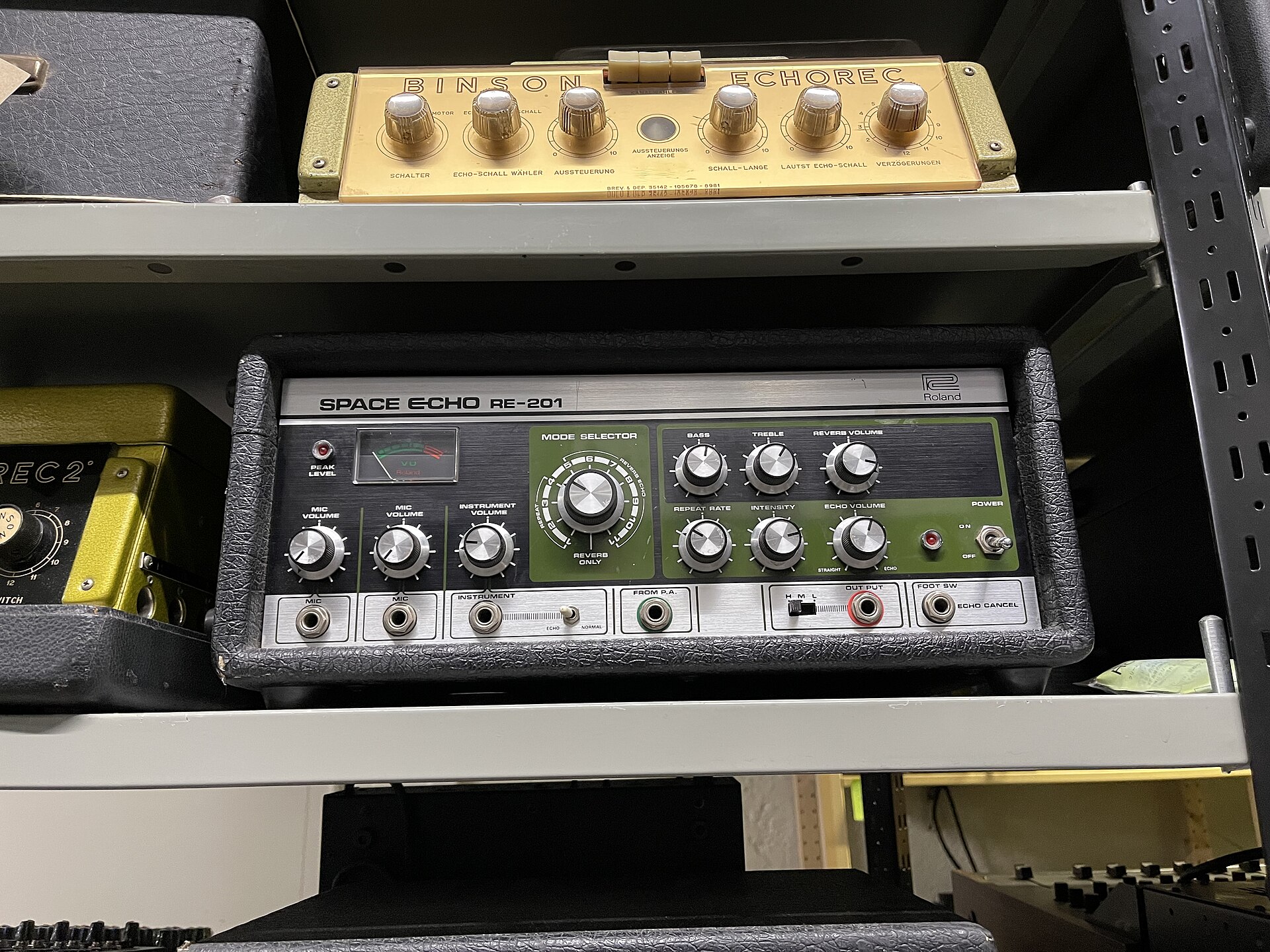
A Loop That Never Stops Snaking: How the Roland Space Echo Turned Delay Into an Instrument for Dub
Most effects are designed to sit still. You set them, you forget them, and the song plays through them. The Roland RE-201 Space Echo was built as a practical tool for touring musicians, a tape delay that would survive the road. What dub producers in Jamaica discovered is that its controls were just as useful in the middle of a mix as before it. The echo was not a setting. It was a part someone could play.
The Problem With Short Tape
Tape echo works by recording a signal onto magnetic tape and reading it back a moment later from a second head further along the path. The distance between the heads and the speed of the tape decide how long the delay is. Earlier machines either used reels or short loops of tape, and Roland’s own first echo units, the RE-100 and RE-200 of 1973, used a short loop of quarter-inch tape.
Short loops have a weakness: they run under constant tension, and they wear out fast. When Roland replaced those models in 1974 with the RE-101 and the RE-201, the key change was in the transport. Instead of a tight little loop, the RE-201 used a single long loop that snakes loosely inside a chamber under a clear cover, pulled past the heads by a capstan. Wikipedia’s account of the design notes that this free-running transport reduced tape wear, noise, and wow and flutter. Roland also made the tape stop moving when the effect was switched off with the footswitch, which extended its life further.
Three Heads and a Selector
The RE-201 had one record head and three playback heads at different distances along the tape. A rotary mode selector with twelve positions let the player pick which heads were heard, alone or in combination. One head gives a single clean repeat. Two or three heads give overlapping rhythms of echo, each at its own spacing, so that one note can turn into a small pattern.
Two other things made the box more than a delay line. The Repeat Rate control changed the speed of the motor, and with it the delay time. A feedback path sent the delayed sound back into the record head, so that the echoes could repeat and decay, or keep building. And Roland put a spring reverb in the same unit, so the repeats could be thrown into a splashy space without a second piece of gear.
Playing the Machine
Those controls are why the Space Echo found its way into dub. Dub is a remix craft: the producer takes an existing track, drops instruments in and out on the mixing desk, and sends fragments of vocals, snares and horns into echo and reverb. With a tape echo on an auxiliary send, a single snare hit could be fed to the machine and left to repeat. Turning the Repeat Rate while the echoes were still sounding changed the tape speed, so the pitch of the repeats slid up or down. Raising the feedback made them swell instead of fade.
Lee “Scratch” Perry used the Space Echo extensively through the 1970s. His Black Ark studio in Kingston, which opened in 1973, ran on modest equipment: a TEAC four-track tape machine, a Soundcraft desk, an Echoplex and a Roland Space Echo, with a Mu-Tron Bi-Phase among his effects. Four tracks left little room to record every idea separately, so a lot of the sound was made live in the mix, with Perry riding the effects as the tape rolled. The echo unit was as much a part of the performance as any instrument in the room.
From Kingston to Trip-Hop
The same habits travelled. Wikipedia lists the Space Echo across reggae, dub, trip-hop, post-punk and experimental rock, and notes that Portishead and Radiohead used the tape speed controls to bend pitch. Players also describe its sound as warm and slightly unstable, because tape and motors are never perfectly steady. That instability, which an engineer might have called a flaw, is part of why producers kept it.
Roland built later versions, including the RE-301 Chorus Echo in 1977, rackmount models around 1980, digital units in the late 1980s and, decades later, BOSS pedals that model the original. The RE-201 itself stayed in production into the late 1980s. Its lesson for anyone making electronic music today is about craft rather than nostalgia: the most useful effect is often the one with a few big knobs you can reach while the track is playing, and the courage to move them.
Cover photo: 1904.CC, CC BY 4.0, via Wikimedia Commons





Leave a Reply