

Three Loudspeakers and a Permit: How Berlin’s Love Parade Turned a Street Into a Dancefloor
Most dance music lives indoors. It needs walls to hold the bass in, a door to decide who gets through and a night that ends when the lights come on. Berlin’s Love Parade began by throwing all of that away. On 1 July 1989, a few months before the Wall came down, about 150 people walked down the Kurfürstendamm in West Berlin behind a vehicle carrying loudspeakers, dancing in the drizzle. Nobody called it a festival. On paper it was a political demonstration.
The Paperwork Was the Idea
The parade was the work of Matthias Roeingh, a DJ better known as Dr. Motte, together with his then partner Danielle de Picciotto. Motte has said the idea came to him in the spring of 1989, after hearing about the acid house parties of Britain’s 1988 Summer of Love and seeing people dance in the street. The question was how to bring that energy outdoors in a city with rules about who could use the road.
His answer was to file the event with Berlin’s assembly authority as a demonstration. The motto was “Friede, Freude, Eierkuchen”, a teasing German phrase that translates as peace, joy, pancakes. Motte gave each word a meaning: peace for disarmament, joy through music as a way of communicating, and pancakes for the fair distribution of food. It sounded like a joke, and partly it was, but it also carried a practical point. In Germany, the state pays for policing and cleaning up after a political demonstration. The organizer of a commercial event pays for its own.
The first edition was almost comically small. Motte later described a setup of a few little vans, loudspeakers, generators and tape decks, with the crowd following on foot. Everything, he said, was improvised.
A Club on Wheels
What made the Love Parade different from a rave was its architecture, or rather its lack of one. The dancefloor was the road, and the sound came from moving vehicles. Over the following years the format settled into trucks sponsored by clubs, labels and record shops, usually open-topped and crowded with dancers, each one playing its own selection as it rolled through the crowd. A float was a portable club, and the parade was a city’s worth of them in a single line.
Mixmag’s account of the 1992 edition captures how homemade it still was. A British sound system arrived on a small blue lorry. Berlin’s Planet club decorated its vehicle as a pink cartoon rabbit, and DJ Tanith brought a camouflaged float, returning the following year with a decommissioned Soviet tank. Some of the floats were not trucks at all but cars and other vehicles pressed into service.
From Kurfürstendamm to the Victory Column
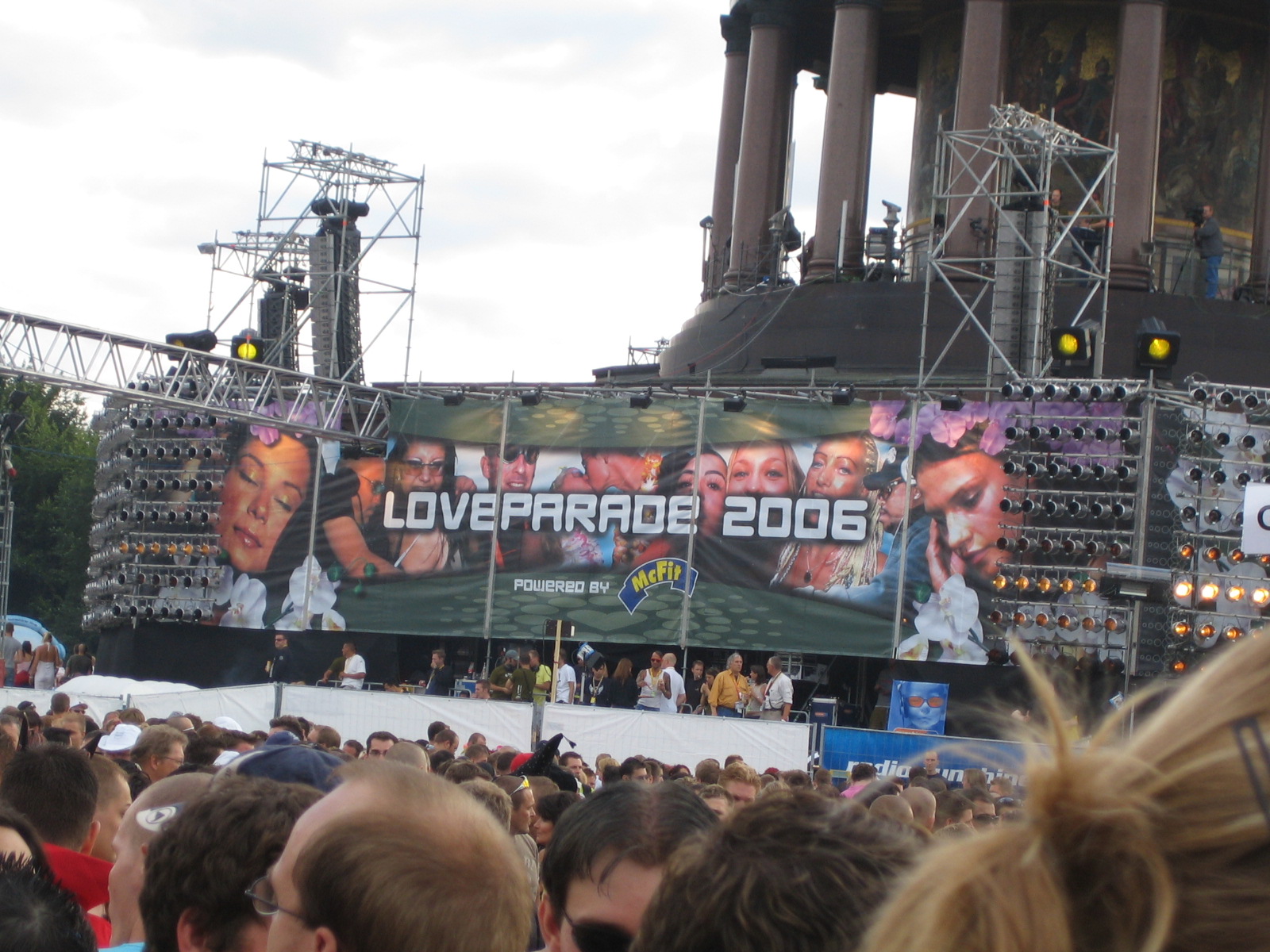
The numbers grew faster than anyone planned for. Wikipedia’s figures, which rely partly on organizers’ estimates that were often disputed, run from about 150 people in 1989 to 2,000 in 1990, 15,000 in 1992 and hundreds of thousands by the mid nineties. By the mid nineties the Kurfürstendamm could no longer hold the crowd, and the parade moved to the Straße des 17. Juni in the Tiergarten, converging on the Siegessäule, the Victory Column, whose golden angel became the event’s emblem. The peak came around 1999, with a reported attendance of about 1.5 million.
The demonstration status was argued over almost every year, because it decided who paid for the cleanup of a city park after a million people had danced in it. In 2001 the courts ruled that the parade had to be held as a commercial event. The Berlin editions of 2004 and 2005 were cancelled over funding, and when a fitness chain revived the parade in 2006, Motte withdrew in protest at its commercialization. The event moved to the Ruhr in 2007, and its history ended at Duisburg in 2010, when 21 people died in a crush at the entrance to the site.
What the Street Remembers
It would be easy to remember the Love Parade only for its size or for its end. The more lasting idea was the first one: that a dancefloor could be claimed as public space, with a permit, a motto and a few speakers on wheels. In 2022 Motte returned to the street with Rave The Planet, a parade in Berlin calling for the city’s electronic music culture to be recognized as heritage. The format he improvised in 1989, a club that moves and a crowd that follows, is still the template every street rave works from.
Cover photo: Denis Apel, CC BY-SA 2.0 de, via Wikimedia Commons
Leave a Reply