

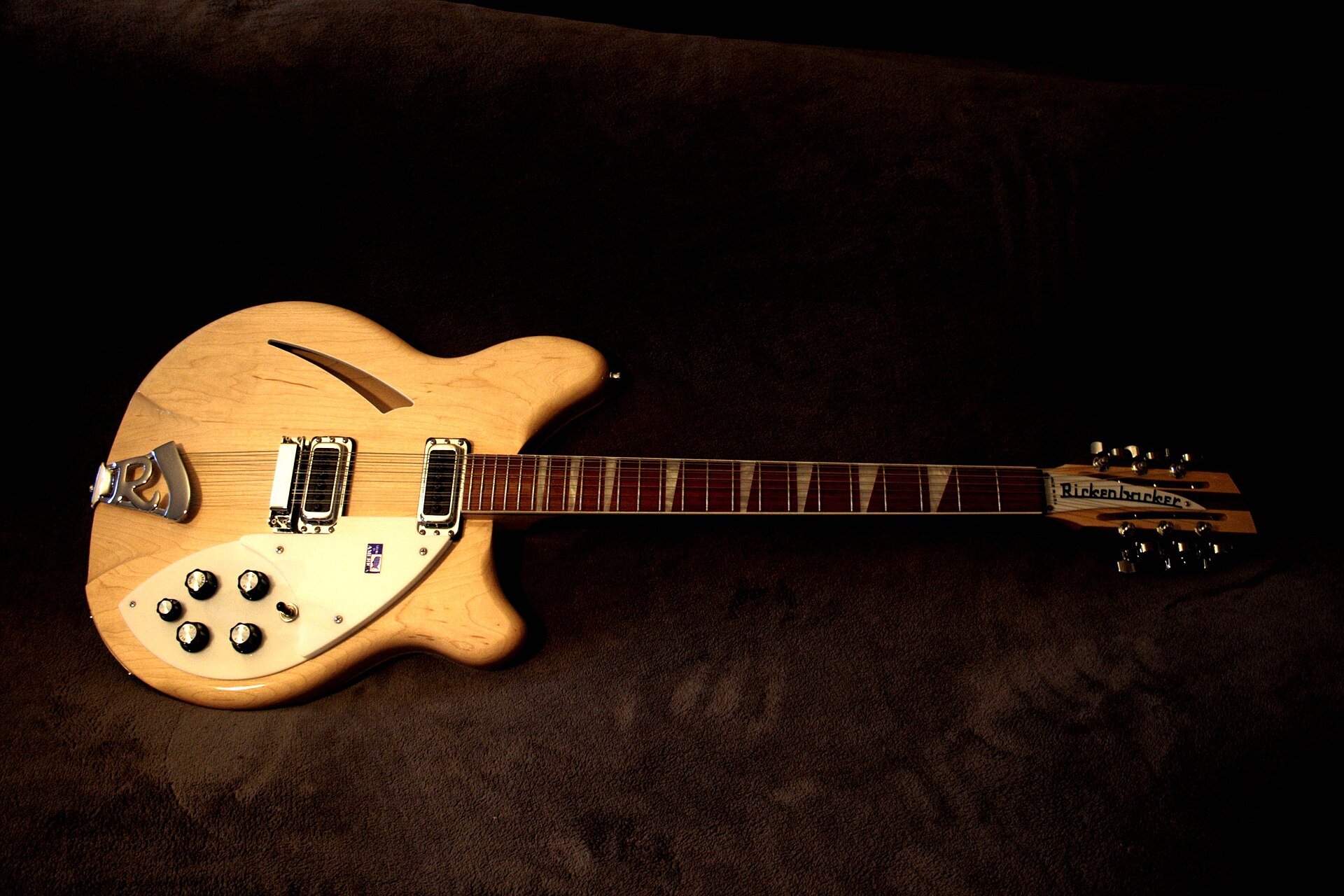
The Thud Before the Shimmer: How Compression and a Reversed String Order Gave the Rickenbacker 12-String Its Jangle
Roger McGuinn once described the Rickenbacker 12-string on its own as “kind of thuddy” and said it did not ring. That is an odd verdict on the instrument that gave folk rock its shimmer, and it points to the real recipe. The jangle was not just a guitar. It was a guitar, a picking hand and a compressor working together.
A Prototype in the Right Hands
The 360/12 reached the world through George Harrison. Sources differ on the details: one account calls his guitar the twelve-string prototype, another dates it to December 1963 and calls it the second Rickenbacker 12-string ever made. They agree that it came to him in February 1964, during the first American tour, and that he carried it into the sessions for A Hard Day’s Night. Audiences heard that sound before most of them had seen the guitar.
Two Design Choices That Matter
The neck is the first. A Rickenbacker 12-string keeps a conventional six-string width, so the courses sit closer together than on most twelves, which makes it easier to play fast and cleanly. McGuinn later said the narrower neck let him play more freely than an acoustic twelve would have.
The string order is the second. On most 12-strings the higher octave string is struck first in each pair. One account says Harrison’s guitar and later Rickenbacker twelves put the octave string second, so the lower-pitched string is hit first. Sources disagree on whether the prototype was conventional, so treat the exact history with care. What is clear is that Rickenbacker’s layout differs from the usual one, and that this changes the attack.
The Studio Did the Rest
McGuinn saw Harrison with the guitar in the film and, by his own account, bought one for himself. Then came the sessions for the Byrds. Engineer Ray Gerhardt used a great deal of compression, partly, McGuinn recalled, to protect his equipment, and he said two tube compressors were chained in series on the way to the board. The result evened out the sharp pluck and stretched each note, which suited an instrument that decays quickly.
One more ingredient was in the hand. McGuinn picked rising banjo-style arpeggios and kept the twelve-string going almost continuously instead of stepping out for solos. Compressed, that steady rolling figure is the sound that took its name from a lyric in Mr. Tambourine Man, released in April 1965.
What a Player Can Take From It
If you want the shimmer, start with the signal chain, not just the guitar. Heavy compression turns a short, bright pluck into a sustained chime, and a continuous picking pattern keeps it moving. Check the string order when you restring, because getting it reversed or not will change how the strings answer your pick. And leave space, because the sound works best as a texture that sits above the rest of the band.
The thud was never the flaw. It was the starting point, and the people who learned to compress it into a chime made one of the most copied guitar sounds in rock.
Cover photo: Hal Hawkins, CC BY 2.0, via Wikimedia Commons






Leave a Reply