

Bring Your Own Amps, Play Your Own Songs: How CBGB’s House Rules Turned a Bowery Bar Into Punk’s Rehearsal Room
The awning promised country, bluegrass and blues. What the room actually delivered was Television, the Ramones, Patti Smith and Talking Heads. The gap between those two things is the story of CBGB, and it was bridged less by vision than by a pair of plain house rules about who carried the amps and whose songs got played.
A Bar With the Wrong Name
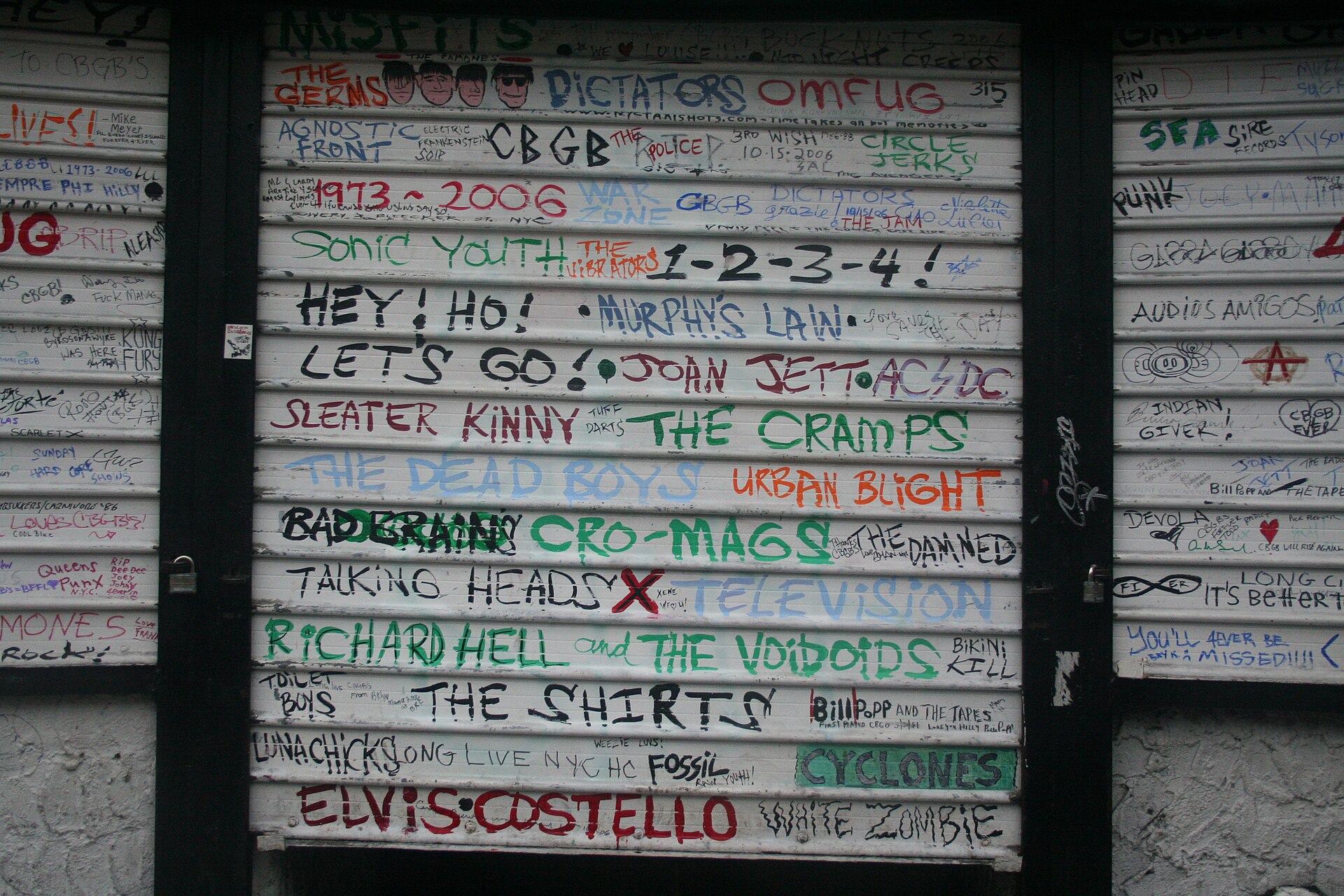
Hilly Kristal opened CBGB at 315 Bowery, at the corner of Bleecker Street, on 10 December 1973. Wikipedia and Diffuser both give 1973; a few accounts say 1974, the year the rock bookings took off. Kristal had managed jazz rooms and run bars before, including a spot on the same stretch of the Bowery, and the building had served as a biker bar and a dive before him.
The letters stood for Country, Bluegrass, Blues. The second line on the awning, OMFUG, meant Other Music For Uplifting Gormandizers. Kristal later wrote that he picked it to sound a little crude, and the spelling still varies from source to source. The country plan never really took. The other music did.
The Sunday That Opened the Door
How rock got in depends on who tells it. Wikipedia credits Richard Hell and Tom Verlaine with talking Kristal into a Sunday night slot for Television in spring 1974. Guitarist Richard Lloyd, telling the band’s story to Uncut, gives the credit to their manager Terry Ork, who guaranteed he would fill the place. Lloyd says Kristal knew nothing about rock music and gave them four Sundays in a row.
Either way, the deal had a condition attached. By Lloyd’s account Ork offered to handle the bookings, as long as everyone understood it was Television’s place. New bands auditioned, and Lloyd was consulted on who got in. A dead weeknight became a showcase run by the musicians themselves.
Two Rules on a Small Stage
The policy that made CBGB matter was simple. According to Wikipedia, a band had to move its own equipment and play mostly original songs. Regulars still slipped one or two covers into a set, so the rule was looser than the legend of a total cover ban suggests. Dana Kristal later said part of the motive was avoiding performing rights royalties on other people’s songs.
Whatever the reason, the effect on the music was enormous. A room of about 350 people that asked for original material became a place where unsigned bands could fail in public, week after week, until they found a sound. The Ramones played their first CBGB show on 16 August 1974 and, according to 6sqft, returned more than 70 times that year alone. That is not a gig history. That is rehearsal with an audience.
Hauling your own gear mattered too. With no house backline to lean on, every band arrived with its own amplifiers and its own idea of volume. The guitar sounds that came out of the Bowery, from Television’s interlocking leads to the Ramones’ downstroke wall, were shaped by players who owned every link in their signal chain.
The Last Night
CBGB ran for 33 years. Its landlord, the Bowery Residents’ Committee, a homeless services nonprofit, took the club to court in 2005 over roughly $90,000 in disputed rent. A judge found the rent increases had never been properly billed, but the club still agreed to leave the building.
Patti Smith played the final show on 15 October 2006, two sets that ran past one in the morning, with Richard Lloyd and Flea joining her. Diffuser and Wikipedia both report that she closed with Elegie after reading out the names of punk musicians who had died. The building became a clothing boutique in 2008.
What survives is not the room but the model: a small stage, a booker who listens to the bands, and a rule that the songs have to be yours. Every DIY venue that asks a new act to bring its own amps and its own material is still running on CBGB’s house rules.
Cover photo: Romanontheprowl, CC BY-SA 3.0, via Wikimedia Commons




Leave a Reply